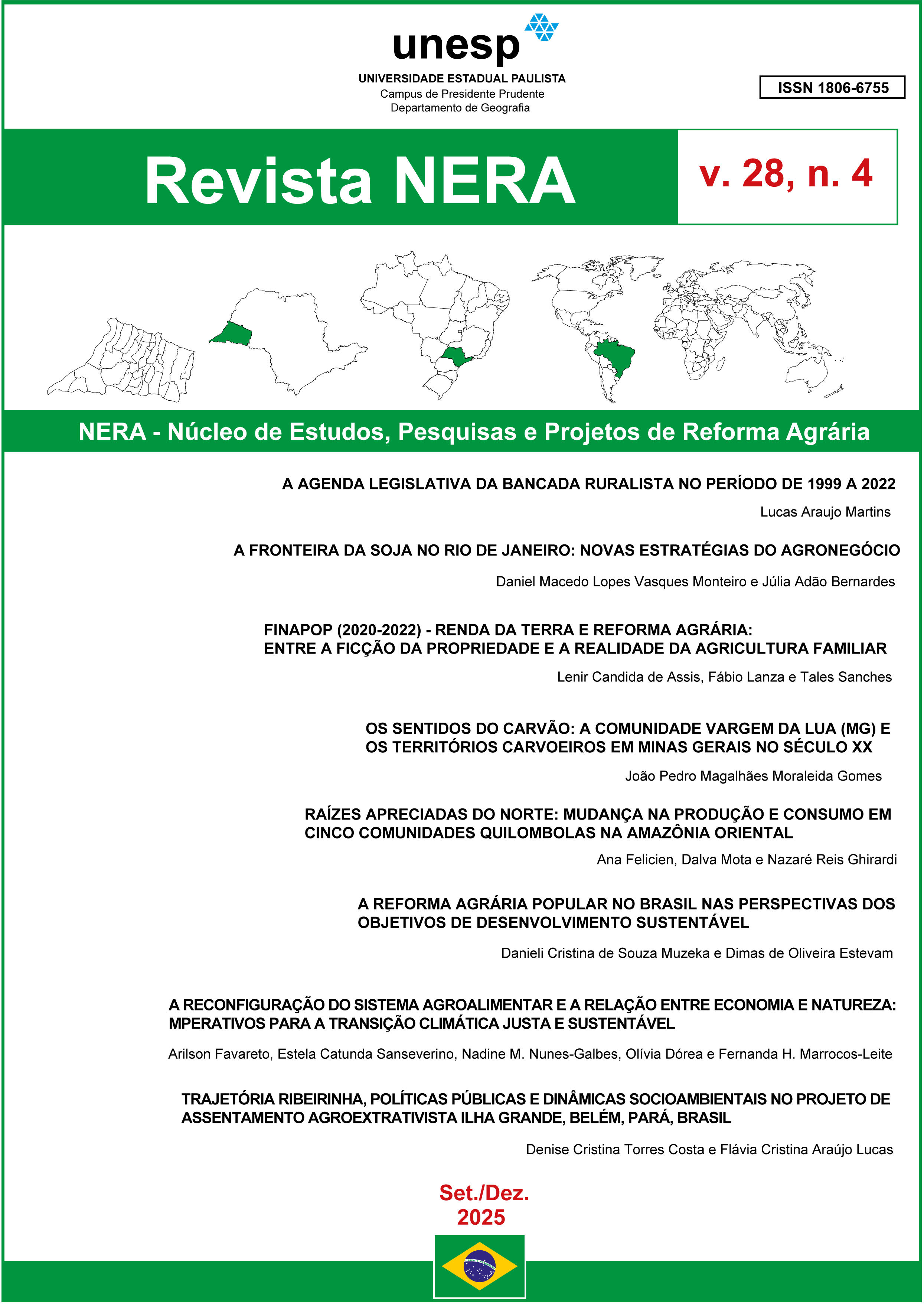
FINAPOP (2020–2022) Land Rent and Agrarian Reform: Between the Fiction of Property and the Reality of Family Farming
DOI:
https://doi.org/10.1590/1806-675520252811072Keywords:
Land rent, family farming, rural cooperativism, agroecology, FINAPOPAbstract
The concentration of agricultural land in Brazil is historically and structurally marked by land inequality, the exploitation of rural labor, and capitalist domination over natural resources. In this context, initiatives such as FINAPOP (Popular Financing of Family Farming) emerge as a counterpoint to the hegemonic logics of agribusiness and land rent. This article aims to analyze the FINAPOP experience as an alternative proposal to the traditional agribusiness financing model, in order to democratize access to agricultural credit and strengthen sustainable agroecological-based projects. Resulting from a doctoral thesis and a master's dissertation at the State University of Londrina (UEL), this study adopts a qualitative methodology. It is theoretically and epistemologically grounded in historical-dialectical materialism, supported by a theoretical review based on Marx (1985) and Martins (1996), as well as field observation in the visited settlements. The main result of the article is to present the model of popular financing that challenges the logic of land rent under capitalism, proposes new paradigms of the relationship between society and agricultural production, and strengthens rural struggles for dignity and food sovereignty.
Downloads
Downloads
Published
Issue
Section
License
Copyright (c) 2025 REVISTA NERA

This work is licensed under a Creative Commons Attribution 4.0 International License.
Os artigos publicados na Revista NERA devem seguir, obrigatoriamente, as diretrizes sobre ética e integridade na prática científica do Conselho Nacional de Desenvolvimento Científico e Tecnológico (CNPQ), disponíveis em seu sitio na internet (http://memoria.cnpq.br/normas/lei_po_085_11.htm). Em caso de infração às referidas diretrizes por qualquer texto publicado, o artigo será formalmente retirado de publicação, conforme a prática da comunidade científica internacional. A submissão de qualquer texto à Revista NERA implica na aceitação plena deste procedimento. As ideias e conceitos emitidos nos artigos são de inteira responsabilidade dos autores. Reforçamos que após a publicação do artigo o mesmo não será despublicado caso haja solicitação por parte dos(as) autores(as).
Lembramos que todos os manuscritos submetidos à Revista NERA são vereficados no software de similaridade "iThenticate". Os manuscritos com plágio verificado são automaticamente negados e os(as) autores(as) comunicados.
A licença utilizada pela Revista NERA é Creative Commons - Atribuição 4.0 Internacional (CCBY 4.0).
A política de arquivamento é a Licença LOCKSS.